Imagine waking up feeling stuck. You grab a popular self-help book off your shelf, read it cover to cover, and change absolutely nothing about your routine. Why? Because a book about scaling a business won’t help if your real problem is chronic procrastination. Whether you’re trying to build better habits, become more confident, improve your career, or simply grow as a person, the right self-development book can change the way you think and act. The challenge is choosing from thousands of titles.
This guide helps you find the best self-development books based on your personal goals, reading experience, and stage of life, ensuring your next read is truly life-changing.
What Are Self-Development Books?
Self-development books (also known as personal development books or self-help books) are actionable guides designed to help readers improve their habits, mindset, emotional intelligence, career, or personal relationships. The best self-development books provide proven frameworks and practical exercises rather than just motivational fluff.
In this guide, you’ll learn:
- Best books for beginners
- Books by life goals
- Books for students
- Books for professionals
- How to choose the right book
- Reading order
- Key lessons from each title
Table of contents
- What Are Self-Development Books?
- How We Selected These Self-Development Books
- Best Self-Development Books at a Glance
- Which Self-Development Book Should You Read?
- Best Self-Development Books by Goal
- Editor’s Top 10 Picks
- Most Recommended Self-Development Books by Experts
- Self-Development Books for Different Stages of Life
- How to Choose the Right Self-Development Book
- How to Get the Most Value from Every Book
- Common Mistakes Readers Make
- Final Thoughts
- FAQ
How We Selected These Self-Development Books
With thousands of books for personal growth published every year, curating a list of the top 25 requires strict criteria. To ensure we only recommend the best books for self-improvement, we evaluated each title based on:
- Long-term popularity: Has the book stood the test of time, or is it just a passing trend?
- Expert recommendations: Do psychologists, business leaders, and educators recommend it?
- Reader reviews: Do average readers find it accessible and helpful?
- Practical lessons: Does it provide actionable steps, or is it purely theoretical?
- Real-world impact: Are there measurable results from readers who applied the frameworks?
- Relevance in 2026: Does the advice still hold up in our modern, fast-paced, digital world?
Best Self-Development Books at a Glance
| Book | Best For | Reading Level | Key Lesson | Best Rating |
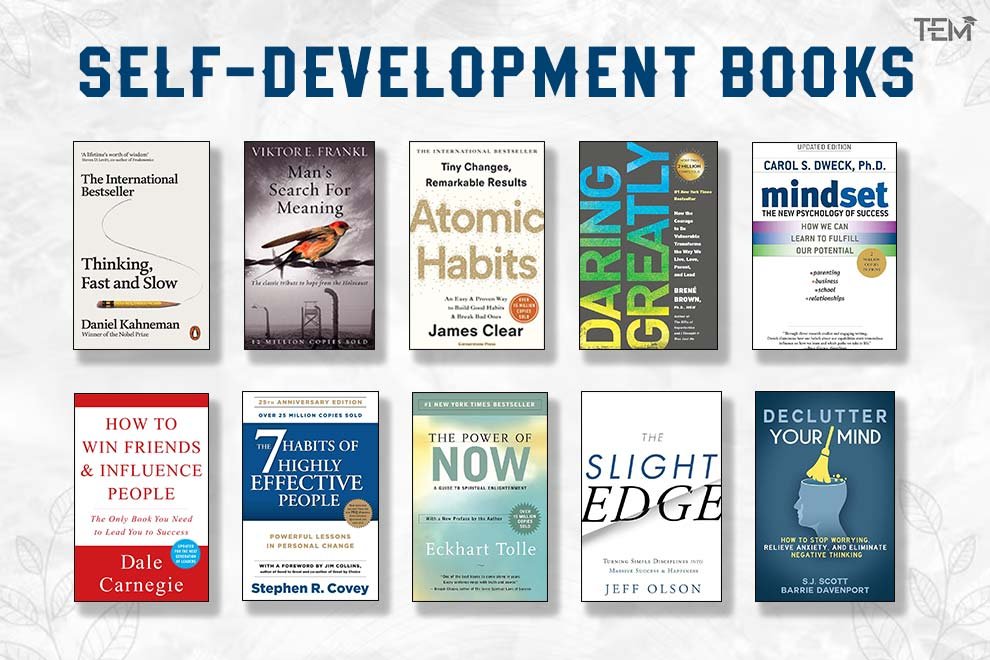
| Atomic Habits | Building daily routines | Beginner | Small 1% changes compound massively. | ⭐⭐⭐⭐⭐ |
| Deep Work | Ultimate productivity | Intermediate | Focus is the new IQ in the modern economy. | ⭐⭐⭐⭐⭐ |
| Daring Greatly | Confidence & vulnerability | Beginner | Vulnerability is a measure of courage. | ⭐⭐⭐⭐⭐ |
| Thinking, Fast and Slow | Decision making | Advanced | Understand your brain’s two operating systems. | ⭐⭐⭐⭐½ |
| Man’s Search for Meaning | Mental resilience | Intermediate | You can survive anything if you have a “why.” | ⭐⭐⭐⭐⭐ |
| Mindset | Students & growth | Beginner | Intelligence can be developed through effort. | ⭐⭐⭐⭐⭐ |
| The Psychology of Money | Financial mindset | Beginner | Wealth is about behavior, not just math. | ⭐⭐⭐⭐⭐ |
| Leaders Eat Last | Leadership | Intermediate | Great leaders sacrifice their own comfort. | ⭐⭐⭐⭐½ |
| How to Win Friends… | Communication skills | Beginner | Be genuinely interested in other people. | ⭐⭐⭐⭐⭐ |
| The Lean Startup | Entrepreneurs | Intermediate | Test ideas quickly to avoid failing big. | ⭐⭐⭐⭐½ |
(See full breakdown of all 25 books below).
Which Self-Development Book Should You Read?
Not sure where to begin? Follow this simple decision guide to find the perfect match for your current challenge:
- Need confidence? ↓ Read The Six Pillars of Self-Esteem
- Need better habits? ↓ Read Atomic Habits
- Need leadership? ↓ Read Dare to Lead
- Need productivity? ↓ Read Deep Work
- Need communication? ↓ Read How to Win Friends and Influence People
- Need motivation? ↓ Read Can’t Hurt Me
- Need career growth? ↓ Read So Good They Can’t Ignore You
Best Self-Development Books by Goal
Here are the 25 best self-development books, categorized by the exact goal you are trying to achieve.
Best Books for Building Better Habits
1. Atomic Habits by James Clear
- Why read it? It is the undisputed king of habit-building in the modern era.
- Key lessons: Focus on systems over goals; try to get 1% better every day.
- Who it’s for: Anyone struggling with procrastination.
- Reading difficulty: Easy
- Time to finish: 5-6 hours
- Practical takeaway: Habit stack by attaching a new habit you want to build to an existing daily behavior (e.g., meditating after you brush your teeth).
2. The Power of Habit by Charles Duhigg
- Why read it? It breaks down the neuroscience behind why we do what we do.
- Key lessons: Every habit has a cue, routine, and reward.
- Who it’s for: Readers who love science-backed insights.
- Reading difficulty: Intermediate
- Time to finish: 7-8 hours
- Practical takeaway: Identify the cue triggering your bad habit and swap out the routine while keeping the reward the same.
3. Tiny Habits by BJ Fogg
- Why read it? Created by a Stanford behavior scientist, it focuses on starting incredibly small.
- Key lessons: Motivation is unreliable; rely on simplicity instead.
- Who it’s for: People who feel overwhelmed by big goals.
- Reading difficulty: Easy
- Time to finish: 5 hours
- Practical takeaway: Scale your desired habit down to a 30-second action (like doing a single push-up) to guarantee consistency.
Best Books for Productivity
4. Deep Work by Cal Newport
- Why read it? It is the ultimate antidote to our distracted, notification-heavy world.
- Key lessons: The ability to focus without distraction is becoming increasingly rare and valuable.
- Who it’s for: Office workers, creatives, and students.
- Reading difficulty: Intermediate
- Time to finish: 6 hours
- Practical takeaway: Schedule “deep work” blocks on your calendar where email and phones are strictly off-limits.
5. Getting Things Done by David Allen
- Why read it? It’s the foundational text for modern task management.
- Key lessons: Your mind is for having ideas, not holding them.
- Who it’s for: People drowning in tasks and emails.
- Reading difficulty: Intermediate
- Time to finish: 7 hours
- Practical takeaway: If a task takes less than two minutes, do it immediately. Otherwise, put it in a trusted system.
6. The ONE Thing by Gary Keller
- Why read it? It forces you to ruthlessly prioritize.
- Key lessons: Multitasking is a lie; exceptional results require singular focus.
- Who it’s for: Entrepreneurs and goal-setters.
- Reading difficulty: Easy
- Time to finish: 5 hours
- Practical takeaway: Ask yourself daily: “What is the ONE thing I can do such that by doing it, everything else will be easier or unnecessary?”
Best Books for Confidence
7. Daring Greatly by Brené Brown
- Why read it? It completely reframes how we view vulnerability and self-worth.
- Key lessons: Vulnerability is not weakness; it is our greatest measure of courage.
- Who it’s for: Anyone dealing with imposter syndrome or fear of judgment.
- Reading difficulty: Easy
- Time to finish: 6 hours
- Practical takeaway: Stop waiting until you are “perfect” to put yourself out there. Step into the arena as you are.
8. The Six Pillars of Self-Esteem by Nathaniel Branden
- Why read it? It’s the definitive psychological guide on how to build true confidence.
- Key lessons: Self-esteem is a practice, not an inherent trait.
- Who it’s for: Those seeking deep, psychological self-improvement.
- Reading difficulty: Advanced
- Time to finish: 8 hours
- Practical takeaway: Practice “living consciously” by being fully present and brutally honest with yourself about your choices.
Best Books for Emotional Intelligence
9. Emotional Intelligence by Daniel Goleman
- Why read it? It popularized the concept of EQ and explains why it matters more than IQ.
- Key lessons: Self-awareness and empathy are critical for lasting success.
- Who it’s for: Professionals and anyone looking to improve relationships.
- Reading difficulty: Intermediate
- Time to finish: 9 hours
- Practical takeaway: When triggered, take a mandatory pause to identify the specific emotion you are feeling before reacting.
10. Thinking, Fast and Slow by Daniel Kahneman
- Why read it? A Nobel laureate breaks down the exact cognitive biases that ruin our decisions.
- Key lessons: We have a fast, emotional brain (System 1) and a slow, logical brain (System 2).
- Who it’s for: Analytical thinkers and leaders.
- Reading difficulty: Advanced
- Time to finish: 12+ hours
- Practical takeaway: Never make a major life or financial decision using “System 1” (gut instinct); force yourself to write out the data.
11. How to Win Friends and Influence People by Dale Carnegie
- Why read it? It is the most legendary communication book ever written.
- Key lessons: You can make more friends in two months by being interested in them than in two years of trying to get them interested in you.
- Who it’s for: Literally everyone.
- Reading difficulty: Easy
- Time to finish: 6 hours
- Practical takeaway: Use a person’s name frequently in conversation it is the sweetest sound in any language to them.
Best Books for Leadership
12. Leaders Eat Last by Simon Sinek
- Why read it? It redefines leadership from authority to biology and empathy.
- Key lessons: Great leaders create a “Circle of Safety” for their teams.
- Who it’s for: Managers, CEOs, and team captains.
- Reading difficulty: Easy
- Time to finish: 7 hours
- Practical takeaway: Prioritize the well-being of your subordinates over your own metrics, and loyalty will naturally follow.
13. Dare to Lead by Brené Brown
- Why read it? It combines vulnerability research with corporate leadership.
- Key lessons: Clear is kind. Unclear is unkind.
- Who it’s for: Modern leaders building inclusive cultures.
- Reading difficulty: Intermediate
- Time to finish: 7 hours
- Practical takeaway: Have tough, honest conversations instead of avoiding conflict out of artificial politeness.
14. The 21 Irrefutable Laws of Leadership by John C. Maxwell
- Why read it? It provides a structured, timeless framework for what makes a leader.
- Key lessons: Leadership is influence nothing more, nothing less.
- Who it’s for: Aspiring managers and executives.
- Reading difficulty: Easy
- Time to finish: 6 hours
- Practical takeaway: Apply the “Law of the Lid”: your leadership ability determines your organization’s effectiveness. Work on yourself first.
Best Books for Students
15. Mindset: The New Psychology of Success by Carol S. Dweck
- Why read it? It will fundamentally change how students view tests, failures, and learning.
- Key lessons: A fixed mindset limits you; a growth mindset unlocks your potential.
- Who it’s for: Students, educators, and lifelong learners.
- Reading difficulty: Easy
- Time to finish: 6 hours
- Practical takeaway: Add the word “yet” to the end of negative statements (e.g., “I don’t understand calculus… yet“).
16. Make It Stick by Peter C. Brown
- Why read it? It debunks everything we think we know about studying.
- Key lessons: Re-reading notes is a waste of time; active recall and spaced repetition are how you actually learn.
- Who it’s for: High school and college students.
- Reading difficulty: Intermediate
- Time to finish: 7 hours
- Practical takeaway: Instead of highlighting a textbook, close the book and write down everything you can remember on a blank piece of paper.
Best Books for Career Growth
17. So Good They Can’t Ignore You by Cal Newport
- Why read it? It destroys the myth of “follow your passion.”
- Key lessons: Passion comes after you get undeniably good at a rare and valuable skill.
- Who it’s for: Young adults and those feeling lost in their careers.
- Reading difficulty: Intermediate
- Time to finish: 6 hours
- Practical takeaway: Focus on building “career capital” (hard skills) rather than waiting to discover your life’s true calling.
18. Range by David Epstein
- Why read it? It validates generalists in a world obsessed with early specialization.
- Key lessons: Diverse experiences and delayed specialization lead to better long-term problem-solving.
- Who it’s for: Career transitioners and multi-passionate people.
- Reading difficulty: Intermediate
- Time to finish: 8 hours
- Practical takeaway: Don’t be afraid to pivot careers; your previous, unrelated experiences will give you a unique edge.
Best Books for Entrepreneurs
19. The Lean Startup by Eric Ries
- Why read it? It’s the modern bible for starting a business without going bankrupt.
- Key lessons: Build a Minimum Viable Product (MVP) and test it with real customers immediately.
- Who it’s for: Founders and side-hustlers.
- Reading difficulty: Intermediate
- Time to finish: 7 hours
- Practical takeaway: Stop trying to perfect your product in secret. Launch it ugly, get feedback, and pivot.
20. Zero to One by Peter Thiel
- Why read it? It forces you to think completely differently about innovation.
- Key lessons: Competition is for losers; aim to create a monopoly by inventing something entirely new.
- Who it’s for: Tech entrepreneurs and big thinkers.
- Reading difficulty: Intermediate
- Time to finish: 5 hours
- Practical takeaway: Ask yourself: “What important truth do very few people agree with you on?” That is where your best business idea lies.
Best Books for Financial Mindset
21. The Psychology of Money by Morgan Housel
- Why read it? It proves that wealth has very little to do with how smart you are and a lot to do with how you behave.
- Key lessons: Compounding takes time; doing nothing is often the best investment strategy.
- Who it’s for: Anyone wanting to build wealth without stress.
- Reading difficulty: Easy
- Time to finish: 5 hours
- Practical takeaway: Increase your savings rate by keeping your ego in check and not upgrading your lifestyle every time you get a raise.
22. Rich Dad Poor Dad by Robert Kiyosaki
- Why read it? It fundamentally changes how you view money and assets.
- Key lessons: The poor work for money; the rich make money work for them.
- Who it’s for: Financial beginners.
- Reading difficulty: Easy
- Time to finish: 6 hours
- Practical takeaway: Stop buying liabilities (things that cost money) and start buying assets (things that put money in your pocket).
Best Books for Mental Resilience
23. Man’s Search for Meaning by Viktor Frankl
- Why read it? A profound memoir by a Holocaust survivor about the psychology of suffering.
- Key lessons: You cannot control what happens to you, but you can control your response and the meaning you assign to it.
- Who it’s for: Anyone going through a difficult life transition or depression.
- Reading difficulty: Intermediate
- Time to finish: 5 hours
- Practical takeaway: When you cannot change a situation, you are challenged to change yourself. Find your “why” to survive any “how.”
24. Can’t Hurt Me by David Goggins
- Why read it? It will completely shatter your perceived limitations.
- Key lessons: When your mind says you’re done, you’re only at 40% of your actual capacity.
- Who it’s for: Athletes and anyone needing a massive kick in the pants.
- Reading difficulty: Easy (Warning: Explicit language)
- Time to finish: 8 hours
- Practical takeaway: Create an “accountability mirror” look yourself in the eye every morning and be brutally honest about your flaws and goals.
25. Meditations by Marcus Aurelius
- Why read it? Written 2,000 years ago by a Roman Emperor, it is the bedrock of Stoicism.
- Key lessons: You have power over your mind, not outside events. Realize this, and you will find strength.
- Who it’s for: Overthinkers and those seeking tranquility.
- Reading difficulty: Advanced
- Time to finish: 6 hours
- Practical takeaway: Keep a daily journal to reflect on your actions, manage your ego, and accept the things you cannot change.
Editor’s Top 10 Picks
While all 25 books are incredible, if we had to narrow it down to the absolute best books for personal growth, these ten stand out. Instead of simply repeating rankings, here is exactly why these ten deserve a permanent spot on your shelf:
- Atomic Habits: It bridges the gap between wanting to change and actually knowing how to change on a practical, daily basis.
- Man’s Search for Meaning: Unmatched in its ability to put modern, trivial problems into perspective.
- The Psychology of Money: It is the only finance book that realizes money is a psychological game, not a math equation.
- Deep Work: The most urgent book on this list. Focus is rapidly becoming a superpower in 2026.
- Mindset: It addresses the root cause of fear of failure better than any other book.
- How to Win Friends and Influence People: Human nature hasn’t changed since 1936. This is still the ultimate networking guide.
- Daring Greatly: It strips away toxic hustle culture and replaces it with genuine human connection.
- Thinking, Fast and Slow: It humbles you by revealing how deeply flawed your own brain’s logic can be.
- So Good They Can’t Ignore You: It provides incredibly refreshing, pragmatic career advice that goes against the cliché grain.
- Meditations: Proof that humans have been battling anxiety, ego, and purpose for thousands of years.
Most Recommended Self-Development Books by Experts
When curating the best self-improvement books, it helps to look at what the experts are reading. These titles are frequently cited across various industries:
- By Business Leaders: The Lean Startup and Deep Work are practically mandatory reading in Silicon Valley and Fortune 500 boardrooms because they drive efficiency and innovation.
- By Educators & Psychologists: Mindset and Thinking, Fast and Slow are heavily recommended in academic circles for their rigorous, evidence-based approaches to human behavior.
- By Entrepreneurs: Zero to One and The ONE Thing are highly praised for teaching founders how to prioritize focus and build massive value in saturated markets.
We avoid turning this into a celebrity list. What matters isn’t who recommended them, but the fact that these books are used as foundational tools by high performers.
Self-Development Books for Different Stages of Life
A book that is life-changing at 18 might be useless at 40. Here is how to map your reading to your life stage:
- High School Students: Mindset – Helps teenagers navigate academic pressure and build a love for learning rather than a fear of bad grades.
- College Students: Make It Stick – The ultimate hack for studying smarter, saving time, and actually retaining information for exams.
- Young Professionals: So Good They Can’t Ignore You – Essential for navigating the messy early years of a career without falling into the “passion trap.”
- Mid-Career Professionals: Deep Work – Necessary for breaking through career plateaus and outperforming distracted colleagues.
- Entrepreneurs: The Lean Startup – A survival guide for building a business without wasting years and thousands of dollars.
- Lifelong Learners: Thinking, Fast and Slow – Perfect for those looking to continually sharpen their intellect and self-awareness as they age.
How to Choose the Right Self-Development Book
With so many motivational books and mindset books available, picking the right one is crucial. Consider these decision factors:
- Current Challenge: Are you procrastinating? Anxious? Broke? Pick a book that directly attacks your biggest bottleneck.
- Reading Style: Do you like storytelling (The Psychology of Money), scientific data (Thinking, Fast and Slow), or actionable steps (Atomic Habits)?
- Experience Level: Beginners should start with highly actionable books (Tiny Habits). Advanced readers can dive into deeper philosophy (Meditations).
- Available Time: If you are incredibly busy, skip the 400-page tomes and start with something punchy like The ONE Thing.
- Goals: Match the book to your 90-day goal. Don’t read a leadership book if your current goal is financial independence.
How to Get the Most Value from Every Book
Buying a book isn’t the same as absorbing it. Here is how to extract maximum value:
- Active reading: Read with a pen in hand. Never read passively.
- Highlighting: Mark passages that challenge your current way of thinking, not just things you already agree with.
- Journaling: After finishing a chapter, write a 3-sentence summary in your own words.
- Applying one lesson at a time: Don’t try to change your whole life. Pick one framework and test it.
- Reviewing notes: Revisit your highlights a month after finishing the book.
- Building habits: Turn the book’s core philosophy into a daily recurring task on your calendar.
Common Mistakes Readers Make
Avoid falling into the “self-help trap” where reading becomes a substitute for doing:
- Reading without action: Consuming 50 books a year is useless if you don’t implement a single idea.
- Buying too many books: Creating a massive unread pile causes anxiety, not growth.
- Following trends instead of goals: Just because a book is trending on TikTok doesn’t mean it solves your current problem.
- Not revisiting important lessons: Great books for personal growth should be reread every few years.
- Reading passively: Treating mindset books like fiction novels guarantees you will forget the lessons in a week.
Final Thoughts
Reading one great book and applying its lessons consistently is more valuable than finishing dozens without taking action.
The books for success on this list are powerful, life-changing tools, but they are just that: tools. They require an operator. Choose the book that matches your current goal, commit to implementing one idea each week, and let your progress guide your next read.
FAQ
- Are self-development books actually helpful?
Yes, self-development books can be highly effective when you apply their lessons consistently. Reading alone isn’t enough; real growth comes from putting
- Which books improve confidence?
The Six Pillars of Self-Esteem by Nathaniel Branden and Daring Greatly by Brené Brown are among the best books for building confidence.
- What are the best self-development books for students?
Mindset by Carol Dweck and Make It Stick by Peter C. Brown, Henry L. Roediger III, and Mark A. McDaniel are excellent choices for students.